|
|
Contents |
| IN THIS ISSUE |
|
|
| August in History |
| Political Cartoon |
| Editor in Chief |
| Michael Apps |
| Staff |
| Jim Morrison |
| Greg Scott |


| Haunted Girl | Halfax and Titanic |
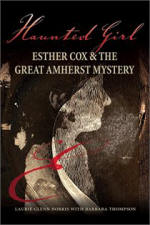 Author:
Laurie Glenn Norris with Barbara Thompson Author:
Laurie Glenn Norris with Barbara ThompsonPublisher : Nimbus Publising: Halifax, 2012
Everyone
loves a good ghost story; while stories written in the style
of the classic authors such as M.R.James have the ability to
make ones’ hair stand on end, it is in historically
true stories of
hauntings that that primitive fear is combined with a line
of inquisitive reasoning. The historical milieus of these
true stories provide the perfect mix of story telling and
realism. Haunted
Girl: Esther Cox & The Great Amherst Mystery is one of
these true stories.
Haunted Girl
follows the story of the late 19th century Nova
Scotian girl named Esther Cox who between 1878 and 1879 was
the focal point of a significant series of hauntings
labelled the Great
Amherst Mystery by contemporaries. The book begins by
placing the reader at the onset of the haunting and proceeds
to describe in wonderful detail the varied symptoms of her
condition. Thunderous noises could be heard throughout
whichever residence Esther resided, while objects moved
around the room, went missing or were literally thrown with
malicious intent at erstwhile observers; the physical
manifestations of the haunting on Esther’s quality of life
are portrayed in immaculate detail.
Haunted
Girl
could have focused solely on the great mystery of Esther’s
haunting and been a welcome addition to the corpus of
Canadian non-fiction writing. What makes
Haunted Girl an
excellent work, is its attempt to merge its narrative with
broader themes concerning the rise of the Spiritualist
movement in North America after the American Civil War, the
philosophical beliefs of the period, the scientific
interpretations of Esther’s condition, and the role of the
female in 19th century North America. Above and
beyond the combination of narrative and broader perspective
offered, Haunted Girl’s
examination of Walter Hubbell, the contemporary opportunist
who used Esther’s story for his own gain, makes Laurie Glenn
Norris’ and Barbara Thompson’s book a worthwhile read for
any fan of the paranormal and of Canadian history.
|
 Author:
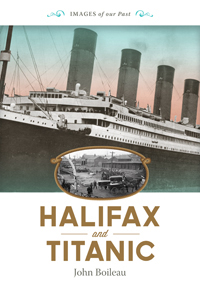
John Boileau Author:
John BoileauPublisher: Nimbus Publishing: Halifax, 2012In April this year, the world
commemorated the 100th anniversary of the
Titanic disaster.
Documentaries were released, podcasts produced, and eminent
works, most notably James Cameron’s opus,
Titanic were
given renewed exposure; these mediums, while accessible, are
limited in their effectiveness. It is in the written word
that the abundance of primary and secondary sources can be
used to establish a real appreciation for the events which
precipitated and coincided with the disaster. From a
Canadian context, however, there has yet to be a recent
contemplation concerning the impact
Titanic had on
the Canadian landscape. Luckily, John Boileau has, in
partnership with Nimbus Publishing, filled this gap in our
knowledge with an exceptional book on Halifax and the
Titanic. What makes
Halifax and Titanic
such a good book is that it is effective as a general survey
of the disaster, while sufficiently specific in its focus to
set it apart from the general body of
Titanic
literature. Supplementing Boileau’s exceptional research and
literary flow are valuable visuals drawn from various
archives and eminent works, which bring a sense of humanity
to the individuals and events described. The accounts of
many of the prominent Canadians involved in the disaster and
their legacy amounts to bringing the tragedy of the
Titanic to a new
level of understanding for Canadians. Although the disaster
of the Titanic
was one hundred years ago, its impact is still felt by the
families across Canada who had relatives perish in the cold
waters of the Atlantic. Only 32% of the passengers of the
Titanic survived
the fateful night of the 15th of April 1912. John
Boileau’s Halifax and
Titanic is a fine addition to the literature concerning
this eminent modern history disaster. Canadians interested
in learning more about the impact of this event on a key
Canadian city, whilst immersing themselves in a detailed and
thought provoking narrative, should place
Halifax and Titanic
on the top of their 2012 reading list. |