|
|
| Contents |
| BOOK REVIEWS |
| THE 1ST CANADA DAY |
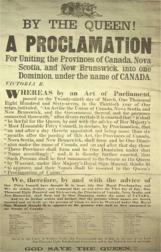
| THE PROCLAMATION |
| THE QUIZ CONTEST |
| PRIMARY SOURCE REVIEW |
|
|
| July in History |
| Political Cartoon |
| Editor in Chief |
| Michael Apps |
| Staff |
| Jim Morrison |
| Greg Scott |
 |
| Next Month |
| LAURIER |
| QUEBEC 1760 |
| Book Reviews |
| The Quiz |
 |
 |
 |
Voyager
| Defending Our Home | Title: Four Wars of 1812 |
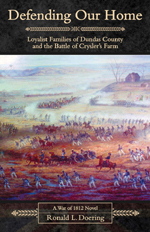 Author:
Ronald L.Doering Author:
Ronald L.DoeringPublisher : Borealis Press: Ottawa, 2012
campaign, the casualties during a skirmish, or the tangible impacts of a
victory (or defeat). What is fundamentally missing from these studies of
bellum mortale is the impact of war on
the individuals and communities involved. Behind each casualty listed on an
after action report is a family; a complex and deeply involved web of human
connections. Ronald L.Doering’s book
Defending Our Home, offers a rich and engaging account of the impact of war
on communities and populations caught up in conflagration.
Taking place during the months leading up to and during the Battle of Crysler’s Farm in 1813, Defending Our Home offers a realistic and human appraisal of the impact of the infamous War of 1812 on Dundas County. Derived from extensive archival research, Defending Our Home recounts Thomas Marselis’ journey from being a relatively uninvolved bystander of a war taking place in distant lands to participating directly in the significant engagement at Crysler’s Farm. Doering skillfully builds tension from the onset; key characters are developed strongly and a natural connection is recreated in the tight knit community of Dundas County. The strongest characteristic of the book is Doering’s exciting and thorough descriptions of the various skirmishes and actions leading up to and during the battle. One cannot help but share in the fear and confusion experienced by the untried and overawed militia as they are ordered to ‘fix bay-o-nets’ and stand in the face of overwhelming odds.
The historical fiction genre has produced relatively little
reading material for the War of 1812 enthusiast. Ronald
L.Doering’s Defending Our Home offers us a fulfilling and
rounded novel which hopefully will inspire other authors to
dive into the wealth of history offered by this period in
Canadian history. Defending Our Homes takes the reader back
in time to a period when Canadians had to decide whether
they would be walked on by belligerent Jonathan, or to
resist and define themselves as a people of their own.
|
 Author:
D.Peter Macleod Author:
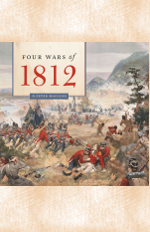
D.Peter MacleodPublisher: Douglas & McIntyre: Toronto, 2012 Not every war culminates in a decisive campaign or field victory; there is rarely a victory which distinguishes the ‘winner’ of a conflict. Debates surrounding the War of 1812 have often confronted this issue. Which side, indeed, ‘won’ the War of 1812? If you asked an American, British or Canadian scholar, one might hear vastly differing stories of who claimed the title. Americans might argue that they won the war on moral grounds (having achieved a measure of symbolic equity in the field of battle), or by the fact that the British did not reclaim territories lost during the War of Independence. The British scholar could argue that the success of the defence of their major territories in North America defined their victory. Canadians would surely mention the identity defining nature of the war, and the significant role they played in key victories such as Crysler’s Farm and Chateauguay.In Four Wars of 1812 D.Peter Macleod offers a fair and balanced appraisal of the arguments for victory on either side. Importantly, while the Canadian, British and American perspectives are offered, the Native American point of view is also considered, which in turn reveals how in the War of 1812, they may have been the only group with a universal claim to defeat. Macleod’s arguments are presented through stimulating written segments working in tandem with high quality prints of political posters, portraits, maps, paintings and various martial accoutrements from the Canadian War Museum; the result is an accessible and thought provoking addition to the corpus of literature on the War of 1812. On the Bicentennial of the War of 1812 there will be much debate over which side ‘won’ the conflict. Four Wars of 1812 is an excellent primer for engaging in these discussions which will surely occur amongst 1812 hobbyist and professional historian alike; the detailed yet accessible qualities of Macleod’s book makes it a perfect gift for a War of 1812 enthusiast in the making. D.Peter Macleod is the pre-confederation historian at the Canadian War Museum, where he curated the exhibits on the Seven Years’ War and the Battle of the Plains of Abraham for the permanent galleries. A longstanding student of 18th-century Canada, he is the author of Northern Armageddon: The Battle of the Plains of Abraham. He lives in Ottawa, Ontario. |
Copyright © 2025 Canada History Society. All Rights Reserved.
mapps@canadahistorysociety.ca
info@canadahistorysociety.ca |
Privacy Policy
| Contact us |
Advertising


